Train Your Balance Before You Think You Need To
Build steadier footing with a simple balance routine that challenges coordination without turning your workout into a circus act.
October 9, 2026 · 4 min read
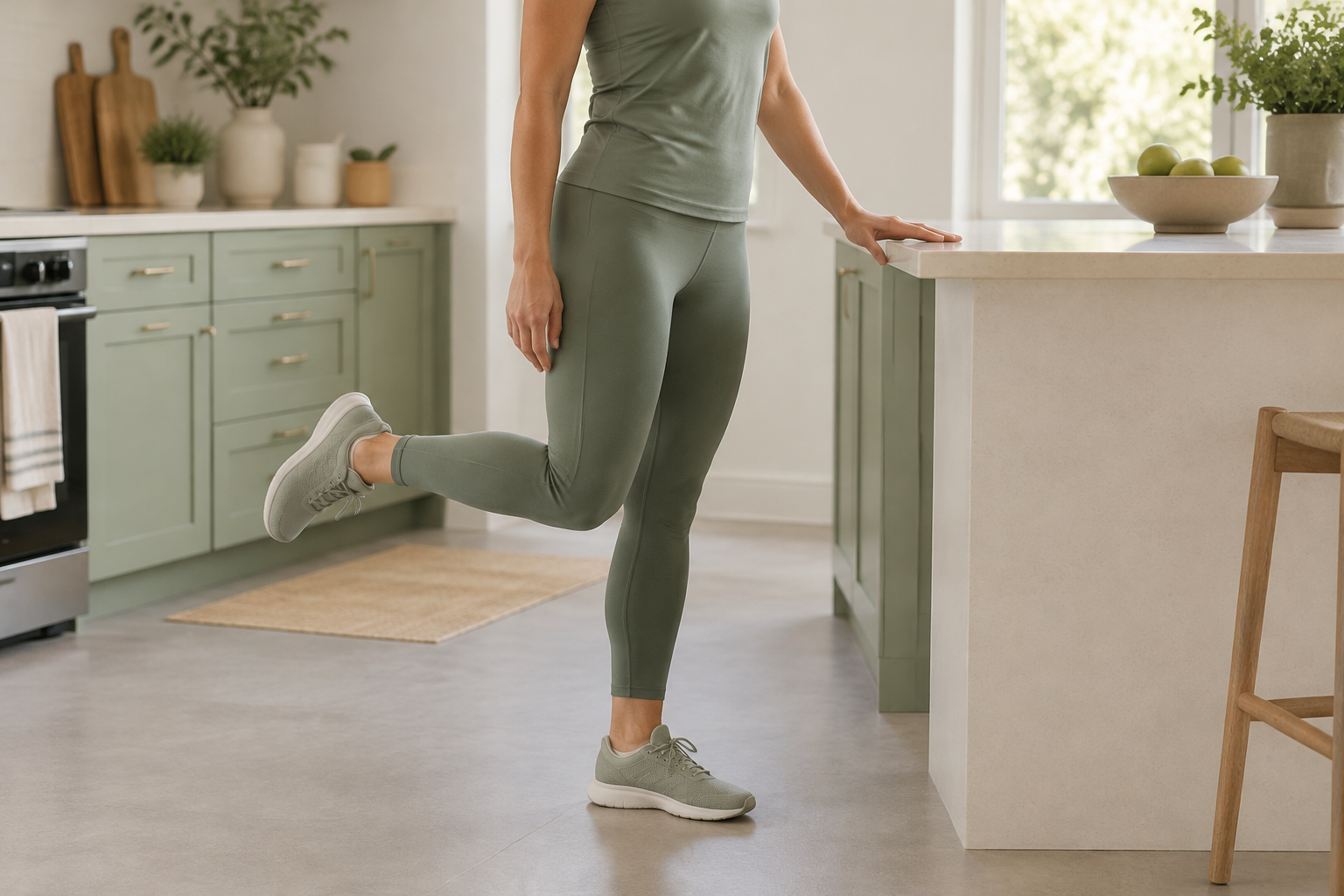
You can finish a demanding workout and still wobble while pulling on a sock. Balance is its own skill: the ability to keep your body controlled as your position, surroundings, and support change.
It matters when you step off a bus, reach for a high shelf, or recover from a stumble on uneven ground. And it deserves practice long before you consider yourself at risk of falling.
The good news? You don’t need a wobble board or an elaborate workout. A few carefully chosen movements, a stable countertop, and several minutes of attention can make balance training an approachable addition to your fitness routine.
Balance Is More Than Strong Ankles
Staying upright is a team effort. Your eyes provide information about your surroundings. Your inner ears help detect head movement and orientation. Sensors in your muscles and joints report where your body is in space. Your brain combines those signals and coordinates a response.
Strength helps you carry out that response, but strength and balance aren’t interchangeable. Standing on one leg requires different coordination from lifting a heavy weight with both feet planted.
Balance is also specific to the task. Holding still, stepping sideways, and turning while moving challenge overlapping—but not identical—abilities. That’s why a useful routine includes both steady holds and controlled movement.
The evidence is particularly strong for older adults: exercise programs that challenge balance and practice functional movements can reduce falls. For younger adults, balance work can build task-specific control, though it isn’t a guarantee against injury.
Set Up a Challenge, Not a Dare
Practice beside a sturdy kitchen counter or a fixed railing, with a clear, nonslip floor beneath you. Avoid relying on a rolling chair, towel rack, or lightweight table for support. Wear secure shoes, or practice barefoot if that feels comfortable and safe; skip slippery socks.
Start when you feel fresh, not immediately after an exhausting workout. A little wobble is useful feedback. Repeatedly grabbing for support, hopping to recover, or holding your breath means the challenge is too high.
Aim for a level where you can maintain control while keeping a hand on—or hovering just above—your support. Using your fingertips is not cheating. It lets you practice well rather than rehearse near-falls.
If you have recurring dizziness, unexplained unsteadiness, recent falls, or a condition affecting sensation or movement, consult a healthcare professional before starting. A physical therapist can help tailor exercises to your needs. Stop if practice brings on dizziness or pain rather than ordinary muscular effort.
Try This Eight-Minute Balance Session
Begin with about a minute of easy marching beside your counter. Then work through the following movements without rushing. The timings are guides, not targets you must force yourself to meet.
1. Shift your weight. Stand with feet about hip-width apart and knees relaxed. Slowly shift your weight toward one foot, keeping both feet on the floor, then toward the other. Continue for 45–60 seconds. Notice the pressure changing beneath your feet without leaning your whole torso sideways.
2. Narrow your stance. Place one foot slightly ahead of the other, as though standing on two narrow railway tracks. Hold for 20–30 seconds, then switch the front foot. If that feels easy, bring the feet closer to a heel-to-toe line. Keep support within reach.
3. Lift one foot. With your hand on the counter, shift onto one leg and lift the other foot just off the floor. Hold for 10–20 seconds, lower gently, and switch sides. Repeat twice per side. Keep your standing knee soft and your pelvis approximately level.
4. Make small clock taps. Imagine you’re standing at the center of a clock. Keeping most of your weight on one leg, lightly tap the other foot forward, sideways, and backward. Return it beside the standing foot between taps. Complete three slow rounds per side, using the counter as needed. Small, controlled taps beat big reaches.
5. Practice sideways steps. Face the counter and take three or four small steps along it, then return. Keep your feet from crossing and place each foot deliberately. Continue for about a minute, leaving room to stop safely at each end.
Rest whenever you need to. If eight minutes feels like too much, choose two movements and build from there.
Progress Without Adding Circus Tricks
Try the routine three days a week to establish a habit. This short session is a starting point, not a substitute for a structured falls-prevention program when one is needed.
When a movement feels consistently controlled across several sessions, change just one thing: use a lighter touch, hold a position slightly longer, or narrow your stance a little. Keep support available even as you improve.
You don’t need to close your eyes or stand on an unstable surface to make progress. Those changes can sharply increase difficulty and may be inappropriate without supervision.
Track something practical: perhaps you need less hand support during clock taps, or you can lower your lifted foot more smoothly. Avoid comparing your hold time with someone else’s. Balance varies with fatigue, footwear, attention, and the task itself.
Keep your usual aerobic and strength activities, too. Balance practice complements them; it doesn’t replace them. Think of it as a small investment in moving with more options and control.
Key takeaways
- Train both stillness and movement: holds, weight shifts, and controlled steps challenge different balance skills.
- Practice beside sturdy support on a clear, nonslip surface; mild wobbling is enough.
- Start with a few minutes and progress one variable at a time, prioritizing control over difficulty.
- Seek professional guidance for recurring dizziness, unexplained unsteadiness, or recent falls.
This article is for general information and is not a substitute for professional medical advice.